

Progressive Lenses vs Bifocals: What's the Difference and Which Is Better? (Edmonton Optician's Guide)
Progressive Lenses vs Bifocals: What's the Difference and Which Is Better? (Edmonton Optician's Guide)
Written by the Charm Optical Team • April 7, 2026
- What Are Multifocal Lenses?
- How Bifocal Lenses Work
- How Progressive Lenses Work
- Progressive vs Bifocal: Side-by-Side Comparison
- Who Needs Multifocal Lenses? (Presbyopia Explained)
- Adjusting to Progressive Lenses in Edmonton: What to Expect
- Which Is Better for You?
- How Much Do Progressive and Bifocal Glasses Cost in Edmonton?
- Insurance and Direct Billing in Edmonton
- Where to Get Progressive Glasses Near Me in Edmonton
- Frequently Asked Questions
Somewhere around your early to mid-forties, reading a restaurant menu starts requiring some creative arm stretching. The phone screen that used to be perfectly clear now needs to be held at arm's length. Sound familiar? You're dealing with presbyopia, and you're far from alone. Nearly every adult in Edmonton over 40 will experience it.
The fix usually involves progressive lenses or bifocal lenses. Both correct your vision at multiple distances, but they do it in very different ways. This guide breaks down exactly how each type works, what they cost, and how to figure out which one fits your life better. We wrote it based on the conversations we have every day with customers at our South Edmonton optical store.
What Are Multifocal Lenses?
Multifocal lenses are any lenses that correct vision at more than one distance. If you can see clearly far away but struggle with close-up tasks (or vice versa), a multifocal lens combines those corrections into a single pair of glasses so you don't have to swap between two separate pairs.
The two most common types are bifocals and progressives. Trifocals exist too, but they've become fairly rare since progressive lenses can do the same job without visible lines. The Canadian Association of Optometrists notes that progressive addition lenses have become the standard recommendation for most presbyopia patients because of their seamless transition between viewing zones.
Both types are available in virtually any frame style, and both can include coatings like anti-reflective, blue light filtering, or photochromic (transition) tints.
How Bifocal Lenses Work
Bifocals have been around since Benjamin Franklin popularized them in the 1780s. The concept hasn't changed much: the lens is divided into two distinct zones. The upper portion corrects your distance vision (driving, watching TV, seeing across a room), and a smaller segment near the bottom handles close-up tasks (reading, texting, checking price tags).
That lower segment creates a visible horizontal line across the lens. You've probably noticed this on someone's glasses before. The line marks exactly where one prescription ends and the other begins.
Advantages of Bifocals
- No adaptation period. Because the two zones are clearly separated, your brain figures out the system almost immediately. Look down for reading, look straight ahead for distance.
- Wider reading area. The near-vision segment covers a larger portion of the lower lens than the reading zone in most progressives.
- Lower cost. Bifocal lenses are typically less expensive than progressives because they're simpler to manufacture.
- Familiar and straightforward. If you've worn bifocals before and they work for you, there's no compelling reason to switch.
Drawbacks of Bifocals
- No intermediate vision. There's nothing between "far" and "near." Computer screens, dashboards, grocery shelves at arm's length — all fall in a gap that bifocals don't cover.
- The visible line. Some people find it cosmetically distracting. Others simply don't care. This is personal preference, not a functional issue.
- Image jump. When your eye crosses the line between zones, the image can appear to shift or "jump." This takes some getting used to, especially on stairs.
How Progressive Lenses Work
Progressive lenses do the same job as bifocals but without the visible line. Instead of two abrupt zones, the lens power changes gradually from top to bottom. The upper area handles distance, the middle section covers intermediate distances (computer screens, cooking, conversations across a table), and the lower area is for reading and close work.
This gradient transition is why progressives are sometimes called "no-line bifocals," though that's a bit misleading. They're really no-line trifocals, because they add an intermediate zone that standard bifocals lack entirely.
According to the American Academy of Ophthalmology, progressive lenses provide the most natural vision correction for presbyopia because they mimic how your eyes naturally shift focus between distances.
Advantages of Progressive Lenses
- Smooth, natural vision at all distances. No abrupt transitions. Your eyes move naturally through the zones.
- Intermediate vision included. Computer work, cooking, and everything between arm's length and across-the-room is covered.
- No visible line. The lens looks like a regular single-vision lens. Nobody can tell you're wearing multifocals.
- Modern and widely available. Progressive lens technology has improved dramatically. Today's digital free-form designs are far more comfortable than the progressives of even ten years ago.
Drawbacks of Progressive Lenses
- Adaptation period. Most people need one to two weeks to fully adjust. During that time, you may notice slight distortion in your peripheral vision or a "swim" effect when turning your head.
- Narrower reading corridor. The clear reading zone is narrower than a bifocal's reading segment. You learn to point your nose at what you're reading rather than just glancing downward.
- Higher cost. Progressive lenses involve more complex engineering and precise fitting, which adds to the price.
- Fit matters more. Proper measurements (pupillary distance, segment height, frame tilt) are critical. A poorly fitted progressive can cause headaches and blurred spots.
Progressive vs Bifocal: Side-by-Side Comparison for Edmonton Shoppers
Here's everything compared in one place. We've included the details that actually affect your daily experience, not just the technical specs.
| Feature | Progressive Lenses | Bifocal Lenses |
|---|---|---|
| Visible line on lens | No | Yes |
| Distance vision | Yes (upper zone) | Yes (upper zone) |
| Intermediate vision (computer, cooking) | Yes (middle corridor) | No |
| Near/reading vision | Yes (lower zone) | Yes (lower segment) |
| Reading zone width | Narrower corridor | Wider segment |
| Peripheral distortion | Some (sides of lens) | Minimal |
| Adaptation period | 1–2 weeks typical | Minimal (hours to days) |
| Image jump at zone boundary | No | Yes |
| Cosmetic appearance | Looks like regular glasses | Visible line across lens |
| Starting cost at Charm Optical | From $350 (frame + lenses) | Less than progressives |
| Best for | Most people over 40, office workers, active lifestyles | People who want simplicity, primarily need distance + reading only |
Who Needs Multifocal Lenses? (Presbyopia Explained)
Presbyopia is the medical term for the gradual loss of your eye's ability to focus on close objects. It's caused by the natural hardening of the lens inside your eye. This isn't a disease — it happens to everyone, typically starting around age 40 to 45.
The American Academy of Ophthalmology describes presbyopia as a normal part of aging that affects virtually 100% of the population. If you've had perfect vision your entire life, presbyopia will be your introduction to glasses. If you already wear glasses for nearsightedness or astigmatism, you'll need multifocals to handle both your existing prescription and the new reading correction.
Signs You Might Need Progressive or Bifocal Lenses
- You hold your phone or a book farther away to see it clearly
- Small print (medication labels, receipts) has become harder to read
- You get headaches after reading or doing close work for more than 20 minutes
- You find yourself removing your distance glasses to read, then putting them back on to see across the room
- Restaurant menus are harder to read in dim lighting
- You're over 40 and noticing any change in your near vision
If several of these sound familiar, book a comprehensive eye exam. Your optometrist will measure your near-vision add power and recommend whether progressives, bifocals, or even dedicated reading glasses make the most sense for your situation.
Adjusting to Progressive Lenses in Edmonton: What to Expect
This is the question we answer most often at our Ellerslie location: "How long does it take to get used to progressive lenses?" The honest answer is that most people adapt within a week. Some take two. A small percentage take up to a month. And a very small number never quite adjust, usually because the lenses weren't properly fitted in the first place.
Here's a realistic timeline based on what our Edmonton customers typically experience:
| Timeframe | What You'll Likely Experience | Tips |
|---|---|---|
| Day 1–3 | Peripheral softness or slight "swim" when turning your head. Stairs may feel a bit off. You'll catch yourself tilting your head to find the right zone. | Wear them all day (not on-and-off). Turn your head to look at things rather than just moving your eyes. |
| Day 4–7 | The swim effect fades. You start finding the reading zone and computer zone without thinking about it. Head movements become more natural. | Practice reading at different distances. Use them at your desk, in the kitchen, while grocery shopping. |
| Week 2 | Most people feel fully comfortable. Zone transitions feel automatic. The peripheral soft spots are barely noticeable. | If discomfort persists past two weeks, come back for a fitting check. The frame position may need adjusting. |
| Week 3–4 | Full adaptation. You forget you're wearing progressives. Going back to single-vision glasses feels limited. | If you're still struggling at week 3, contact us. We'll re-check measurements and discuss options at no extra cost. |
Tips That Actually Help With Adaptation
- Commit to wearing them full-time. Switching back and forth between your old glasses and new progressives slows down adaptation significantly.
- Point your nose, not just your eyes. Progressives work best when you turn your whole head toward what you're looking at, rather than just shifting your gaze to the side.
- Be careful on stairs for the first few days. Tilt your head down slightly so you're looking through the distance zone (upper part), not the reading zone.
- Higher-quality lenses adapt faster. Digital free-form progressives have wider corridors and less peripheral distortion than older designs. This is one area where spending a bit more genuinely makes a difference.
- Get the fit checked. If something still feels off after a week, come see us. A small frame adjustment can fix what feels like a major problem.
Which Is Better for You?
There's no universal "better" here. The right choice depends on your daily life, your prescription, and frankly, your patience during the first week or two.
Progressives tend to be the better fit if you:
- Spend time on a computer, tablet, or phone throughout the day (intermediate vision matters)
- Want one pair of glasses that handles everything from driving to reading
- Prefer the cosmetic look of a lens without a visible line
- Lead an active lifestyle and don't want to swap between glasses
- Are getting multifocals for the first time (adapting to progressives from the start is easier than switching later)
Bifocals tend to be the better fit if you:
- Primarily need just distance and reading, with little in-between use
- Want maximum reading zone width (relevant for people who read for extended periods)
- Have tried progressives before and couldn't adapt
- Prefer the simplicity of two clearly defined zones
- Are looking for a lower-cost option
Most of the customers we see at Charm Optical end up in progressive lenses. Not because we push them, but because most people over 40 in Edmonton spend a significant portion of their day at a computer screen, and that intermediate zone makes a real difference. That said, we fit plenty of bifocals too. If bifocals work for your life, they're a perfectly good choice.
How Much Do Progressive and Bifocal Glasses Cost in Edmonton?
Pricing for multifocal glasses varies quite a bit depending on the frame brand, lens material, and lens design. Here's what you can expect at Charm Optical to give you a real starting point:
- Progressive glasses (frame + lenses): Starting from $350. This includes a quality frame and standard progressive lenses with anti-reflective coating. Premium digital free-form progressives with wider corridors start higher, typically in the $450–$600 range depending on lens features.
- Bifocal glasses (frame + lenses): Generally less than progressives. The simpler lens design keeps the price lower.
- Single-vision glasses: From $99 (frame + lenses). Same-day single-vision is available for many prescriptions.
- Budget-friendly option: Our Momono frames start at $65 complete (frame + single-vision lenses), a good option if you need a dedicated reading pair alongside your progressives.
Lens add-ons like photochromic tinting (lenses that darken in sunlight), blue light filtering, or thinner high-index material will add to the base price. We always walk through these options and their costs before placing your order. No surprises at pickup.
Looking for frames? We carry Ray-Ban, Oakley, Gucci, Calvin Klein, Maui Jim, Burberry, Persol, and more. Any of these can be fitted with progressive or bifocal lenses.
Insurance and Direct Billing for Multifocal Glasses in Edmonton
Most vision insurance plans in Alberta cover a portion of both frames and lenses, including progressive and bifocal lenses. The amount varies by plan, but many policies cover $200–$400 toward glasses every two years.
At Charm Optical, we direct bill to the major Alberta providers so you only pay the difference at pickup:
- Alberta Blue Cross
- Canada Life (formerly Great-West Life)
- Desjardins
- AISH (Assured Income for the Severely Handicapped)
- Alberta Works
If you're not sure what your plan covers, bring your insurance card when you visit and we'll look it up on the spot. Coverage amounts change from plan to plan, so checking before you pick frames helps you budget accurately. Children under 19 and seniors 65+ in Alberta also have eye exam coverage through Alberta Health Care, which can reduce your overall out-of-pocket cost.
Where to Get Progressive Glasses Near Me in Edmonton
If you're searching for progressive lenses or bifocal glasses in the Edmonton area, here's what to look for in an optical store.
Proper fitting is the single most important factor with multifocal lenses, especially progressives. The optical centre, segment height, and pantoscopic tilt all need to be measured precisely. A millimetre off in any direction can mean the difference between lenses that feel perfect and lenses that give you headaches. This is one area where in-person fitting genuinely matters more than online convenience.
At Charm Optical, we're located in South Edmonton at 5035 Ellerslie Rd SW, Edmonton, AB T6X 1X2. We serve patients from Ellerslie, Summerside, Walker, Rutherford, Heritage Valley, and across the south side. If you're coming from Windermere, Callaghan, or the Henday corridor, we're a quick drive off the Anthony Henday.
What makes the fitting process easier here: we take full measurements in-store using your chosen frame, explain each lens option in plain terms, and check the fit when your glasses arrive. If your progressives need adjustment during the adaptation period, bring them back and we'll re-adjust at no charge.
We also ship glasses across Canada, so if you already have a current prescription and know your frame preference, you can order from anywhere in the country.
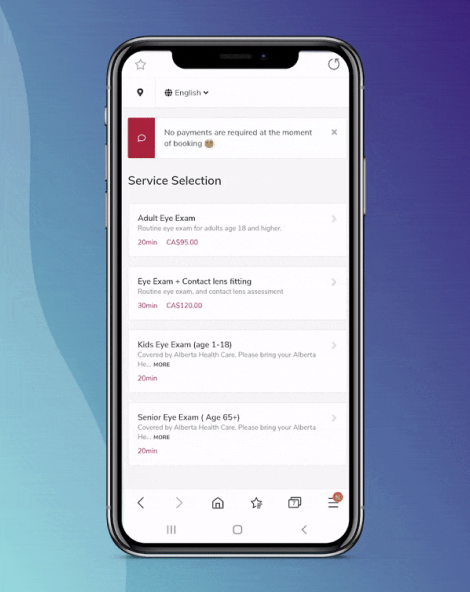
Ready to see whether progressives or bifocals are right for you? Book an eye exam online at see.charmoptical.ca, or give us a call at (780) 490-0090. We're happy to answer your questions before you come in.
Frequently Asked Questions
Are progressive lenses worth the extra cost over bifocals?
For most people, yes. The intermediate zone for computer work and daily tasks is something you'll use constantly. If you spend any meaningful time on screens, progressives will feel noticeably more comfortable than bifocals. That said, if your needs are strictly distance and reading with nothing in between, bifocals do that job well at a lower price.
Can I switch from bifocals to progressive lenses?
Absolutely. Many of our Edmonton customers make this switch. Expect a one-to-two-week adjustment period as your brain learns the new lens layout. The key is to commit to wearing them full-time during adaptation. If you've been happy with bifocals for years, though, there's no medical reason you need to change.
Why do progressive lenses cost more than bifocals?
Progressive lenses use more complex optics. Instead of two simple zones separated by a line, the prescription changes gradually across the entire lens surface. This requires precise digital surfacing and custom calibration based on your individual measurements. Better lens technology (digital free-form, wider corridors) adds further cost, but also significantly improves comfort.
Do progressive lenses make you dizzy?
Some people experience mild dizziness or a "swimming" sensation during the first few days. This is normal and temporary. It happens because your brain is learning to interpret the gradual power change across the lens. Wearing your new glasses consistently (not switching back and forth with old ones) shortens this adjustment period. If dizziness persists beyond two weeks, the fit should be rechecked.
How long do progressive lenses take to get used to?
Most people adapt within one to two weeks. The first three days are the most noticeable. By the end of the first week, zone transitions start feeling automatic. Full adaptation usually happens by week two or three. Wearing them all day from day one (rather than a few hours at a time) speeds up the process considerably.
Can I wear progressive lenses for driving?
Yes. The upper zone of progressive lenses provides clear distance vision for the road, traffic signs, and mirrors. Many drivers actually prefer progressives over bifocals because the intermediate zone lets you see the dashboard clearly without the image jump that bifocals can cause at the zone boundary. Just remember during your first few days: use the upper part of the lens for mirrors and road, and move your head rather than just your eyes.
What's the difference between cheap and expensive progressive lenses?
The main differences are corridor width and peripheral distortion. Budget progressives have a narrower usable corridor (the clear zone running down the centre of the lens) and more blurriness at the edges. Premium digital free-form progressives are calculated point-by-point for your exact prescription and frame measurements, resulting in wider clear zones and faster adaptation. For first-time progressive wearers, a better lens design genuinely makes the adjustment easier.