
Dilated Eye Exam: What to Expect and Can You Drive After?
Dilated Eye Exam: What to Expect and Can You Drive After?
Dilating drops widen your pupil so the optometrist can examine your retina and optic nerve. Expect blurry near vision and light sensitivity for three to four hours. The FDA label for tropicamide, a standard dilating drop, tells prescribers that patients should be advised not to drive while their pupils are dilated. Bring sunglasses and bring a driver.
That is the short version. Below: what the drops do, how long the blur really lasts, what the evidence says about driving, when a photograph is used instead, and who needs a dilated look every year.
- What it isOne or two drops in each eye that hold your pupil open
- Wait in the chair15 to 20 minutes before the doctor looks in
- Blur and glare3 to 4 hours for most people, longer for some
- Does it hurtBrief stinging as the drop goes in, then nothing
- DrivingBring someone. The drug label says do not drive while dilated
- Bring with youSunglasses, your glasses, your medication list
- Cost at CharmComprehensive eye exam $99; diabetic eye exams are covered by Alberta Health Care at any age
Do I need my eyes dilated?
Not at every visit. Dilation gets added when the optometrist needs a clear, wide view of the back of your eye, or when your history says the risk of a hidden problem is high enough to go looking.
It matters because the back of the eye does not announce itself. The National Eye Institute puts it bluntly: a dilated eye exam is "the only way to check for eye diseases early on, when they're easier to treat — and before they cause vision loss."
At Charm Optical, diabetic eye exams are dilated — the page says so plainly, because a diabetic retina has to be seen properly to be graded. A routine comprehensive eye exam includes retinal imaging, and the optometrist decides on the day whether drops are needed on top of that.
Ask before you come
If you need to arrange a ride, or you have to go back to work afterwards, phone ahead. Call (780) 490-0090 and ask whether your appointment is likely to include dilation. It is a 20-second question that saves a wasted afternoon.
What does dilation actually check for?
Your pupil is an aperture. Undilated it is a small hole to aim a light through, and the doctor sees a cone of retina around the centre. Widened, the same hole becomes a window. The National Eye Institute uses a door: "Dilating your pupil lets more light into your eye — just like opening a door lets light into a dark room."
The pupil is the doorway, not the destination
Cross-section of one eye, seen from the side. The teal fan is how much retina the examiner can reach through the opening.
A keyhole view
The examiner reaches the central retina and the optic nerve head. The far edges stay in shadow.
A window view
The peripheral retina comes into range. That is where retinal tears, thinning and early bleeds tend to hide.
With the door open, the optometrist is looking for the diseases that steal sight quietly. The National Eye Institute names three: diabetic retinopathy, glaucoma and age-related macular degeneration. A dilated view also covers the lens, so cataract changes get graded at the same time.
It is also how a retinal detachment gets diagnosed. The National Eye Institute lists the diagnosis for retinal detachment as, simply, a dilated eye exam — and warns that "retinal detachment is a medical emergency."
Same-day, not next-month
If you suddenly see a lot more floaters than usual, flashes in one or both eyes, or a dark curtain at the side or middle of your vision, the National Eye Institute says to go to your eye doctor or the emergency room right away. Call us on (780) 490-0090 and say what you are seeing.
How long does eye dilation last?
Plan on three to four hours. That is the figure Charm Optical gives patients on its diabetic eye exam page, and it matches what most adults report.
The drug labels allow a wider window, and they are worth reading because they explain why one person is fine by lunch and another is squinting at dinner.
| Drop | Typically used for | Starts working | How long the effect lasts |
|---|---|---|---|
| Tropicamide (Mydriacyl) | Routine dilation to examine the fundus; the 1% strength also relaxes focusing | 15 to 30 minutes | "Approximately 3-8 hours." Complete recovery from dilation "in some individuals may require 24 hours" |
| Cyclopentolate (Cyclogyl) | Stronger and longer relaxation of focusing, often used with children | Maximum effect on focusing within 25 to 75 minutes | Focusing recovers in 6 to 24 hours. Complete recovery from dilation "in some individuals may require several days" |
Swipe the table sideways to see every column
Source: FDA prescribing information via DailyMed — Mydriacyl (tropicamide), Alcon and Cyclogyl (cyclopentolate), Alcon.
Why it lasts longer for some people
Eye colour is a real factor. Both labels carry the same sentence: "Heavily pigmented irides may require more doses than lightly pigmented irides." Darker eyes can need an extra drop to open properly, and more drug means a longer tail.
Two other things. Near vision takes the biggest hit, because 1% tropicamide relaxes the muscle that focuses your eye — distance is usually workable while a phone screen is not. And the light sensitivity is not in your head: photophobia is listed on the label as a known effect, alongside "transient stinging" as the drop goes in.
Can I drive after eye dilation?
The drug label answers this directly. Under information for patients, the Mydriacyl label states: "Patient should be advised not to drive or engage in potentially hazardous activities while pupils are dilated." The National Eye Institute says the same thing in plainer words — ask a friend or family member to drive you home. Charm Optical's own guidance is to bring someone.
For years that advice had no measurement behind it. So a team at the Queensland University of Technology drove 16 licensed drivers around a 5.1 km closed-road circuit twice — once with natural pupils, once dilated with 1% tropicamide — and recorded what actually got worse. The results ran in the British Journal of Ophthalmology in 2003.
The finding is more specific than "your vision is worse." Reading road signs was untouched. Judging whether a gap was wide enough was untouched. What collapsed was picking a large, low-contrast object off the road surface — and steering around it.
The dilated drive
One road, one driver, two pupils. Switch the pupil and watch which cues survive — then read what the study actually measured beside it.
- Low-contrast hazards on the road
- High-contrast speed sign and cone gap
- Veiling glare
3.0 mm Natural pupil — the baseline
- Low-contrast hazards seen, of 98.81Baseline
- Low-contrast hazards hit0.25Baseline
- Glare score, letters lost0.19Baseline
- Road-sign items read, of 6554.31Baseline
- Correct gap judgements, of 97.19Baseline
6.7 mm Dilated with one drop of 1% tropicamide
- Low-contrast hazards seen, of 98.06Worse, p = 0.009
- Low-contrast hazards hit1.19Worse, p = 0.008
- Glare score, letters lost4.50Worse, p = 0.007
- Road-sign items read, of 6554.50No change
- Correct gap judgements, of 97.38No change
Not measured Dilated, in dusk or rain
"It is also significant in terms of driving in poor visibility conditions, such as rain or fog, where the contrast of all roadway objects is reduced, and also night-time driving."
The circuit was driven in sunny conditions between 7 and 10.30 am. Rain, fog and darkness were never tested, so this state carries no numbers — the sentence above is the authors' own caution. They add that a late-afternoon appointment is how a dilated patient ends up driving at night, and that 16 drivers aged 19 to 24 with healthy eyes probably understate the effect on older ones.
Pupil dilatation can impair selected aspects of driving and vision performance and patients should be cautioned about these possible effects. Wood, Garth, Grounds, McKay & Mulvahil, British Journal of Ophthalmology, 2003
The numbers cut both ways. Visual acuity dropped by about two letters, contrast sensitivity by one. Nobody drove into a ditch. But hazards hit went from a quarter of one to more than one per lap, and the authors note what those grey sheets stand in for: "potholes, highway debris, real speed bumps, pedestrians, and other vehicles."
The practical translation for an Edmonton afternoon: you will probably feel fine, and feeling fine is not the test. Bring a driver.
Retinal imaging vs dilation: does a photo replace the drops?
Sometimes, and increasingly — but not as a rule. Retinal photographs are part of every exam at Charm Optical, and for a lot of patients that record is what gets compared year over year. Diabetes Canada's clinical practice guideline accepts either route for retinopathy screening: "Screening can be performed with dilated ophthalmoscopy, fundus imaging (photography — preferably standard 7 field or wide field imaging +/- macular OCT) combined with telehealth systems by qualified vision care professionals."
The question is how much retina the camera gets. A 2021 review in the Indian Journal of Ophthalmology gives the numbers: traditional fundus cameras "captured only 30-50° of retina and the peripheral retina remained undocumented," while an ultra-widefield system such as Optos "allows capture of 200 degrees of retina (approximately 82% of retinal surface area) in a single click" and can do it through a small pupil.
Two things follow. First, 82% is a lot and it is not all of it. Second, the same review is careful about where imaging stands today: it is "likely to transpire from an adjunct to a substitute of ophthalmoscopic examination" in specific situations — future tense, specific situations. A camera also needs a clear path. In a 2024 study of 246 cataractous eyes in Eye, "fifty-two eyes (21%) were excluded from appropriate preoperative UWF imaging because of massive lens opacity."
So the honest answer to "can the photo replace the drops" is: for routine monitoring, often. For a symptom that points at the far periphery, or an eye the camera cannot see into, no.
Who should have a dilated exam every year?
Diabetes is the clearest case. Diabetes Canada's guideline for patients is direct: "Diabetic retinopathy often goes unnoticed until vision loss occurs; therefore, people with diabetes should get a comprehensive dilated eye exam regularly."
| If this is you | Recommended interval | Source |
|---|---|---|
| Type 1 diabetes, age 15 or older | Annually, starting 5 years after the onset of diabetes | Diabetes Canada CPG, Grade A |
| Type 2 diabetes | At the time of diagnosis, then every 1 to 2 years if there is no or minimal retinopathy | Diabetes Canada CPG, Grade A |
| Diabetes or high blood pressure | "At least once a year" for most people | National Eye Institute |
| Over age 60 | Every 1 to 2 years | National Eye Institute |
| Family history of glaucoma | Every 1 to 2 years | National Eye Institute |
Sources: Diabetes Canada Clinical Practice Guidelines, Retinopathy chapter; National Eye Institute. Your own interval is set by your optometrist, not by a table.
If you have diabetes, the Alberta detail matters: at Charm Optical, diabetic eye exams are covered by Alberta Health Care at any age, and no referral is needed. Tell us you are diabetic when you book so we can allow time for the drops to work.
How to plan the appointment
A dilated exam is not a big deal. It is a badly planned afternoon that makes it feel like one.
- Bring a driver, or plan a bus, a lift or a walk. This is the one that people regret.
- Bring sunglasses. The National Eye Institute is emphatic about this: "Your eyes may be sensitive to light for a few hours after your exam. Sunglasses can help, so bring them if you have them!"
- Book earlier in the day. The study authors specifically flag late-afternoon appointments, because that is how a dilated driver ends up on the road after dark.
- Do not plan close work afterwards. Reading a contract, marking papers or a screen-heavy shift will be genuinely uncomfortable for a few hours.
- Take your contact lenses out. The tropicamide label says to remove contact lenses before use, so bring your glasses and a case.
- Say what you are taking. Mention your medications and any past problem with eye pressure — the label notes that dilating drops can briefly raise pressure inside the eye.
If you do not own a pair, this is the excuse
Three from our sunglasses range, all with a proper sunglass tint rather than a light fashion wash. Prices as listed at the time of writing.


More in sunglasses. A dark tint is what you want on the drive home — and yes, they can be made in your prescription.
Frequently asked questions about dilated eye exams
Do I need my eyes dilated at every eye exam?
Not always. Dilation is added when the optometrist needs an unobstructed view of the retina and optic nerve, or when your history raises the odds of finding something — diabetes, a family history of glaucoma, new floaters or flashes, or a change already being tracked. Charm Optical dilates for diabetic eye exams. If you want to know before you arrive, call (780) 490-0090 and ask.
How long does eye dilation last?
Plan on three to four hours of blurry near vision and light sensitivity. The FDA label for Mydriacyl, a tropicamide dilating drop, says it acts in 15 to 30 minutes and that the duration of activity is approximately 3 to 8 hours, and that complete recovery from dilation may require 24 hours in some individuals. Stronger drops used for children can take longer still.
Can I drive myself home after eye dilation?
The tropicamide label tells prescribers that patients should be advised not to drive or engage in potentially hazardous activities while their pupils are dilated, and the National Eye Institute says to ask a friend or family member to drive you home. A closed-road test published in the British Journal of Ophthalmology in 2003 found dilated drivers saw fewer low-contrast road hazards and hit more of them, while road-sign reading and gap judgement were unchanged. Bring a driver.
Does eye dilation hurt?
No. The drop stings for a few seconds as it goes in — transient stinging is listed on the label — and then the feeling passes. The pupil opening is not something you can feel. What you notice afterwards is blur at reading distance and how bright everything looks, because a pupil that cannot shrink lets in more light than usual.
Can retinal imaging replace dilation?
For routine monitoring, often. Diabetes Canada accepts either dilated ophthalmoscopy or wide-field fundus imaging for retinopathy screening. But an ultra-widefield camera captures about 200 degrees, roughly 82% of the retinal surface, and a 2021 Indian Journal of Ophthalmology review still describes that imaging as an adjunct that is only likely to become a substitute for ophthalmoscopy in specific situations.
Why do my eyes stay dilated longer than someone else's?
Eye colour is part of it. The FDA labels for both tropicamide and cyclopentolate carry the same line: heavily pigmented irides may require more doses than lightly pigmented irides. More drops, or a stronger drop, means a longer tail. Which drug was chosen, the dose and your age all shift the timeline too.
Who should have a dilated eye exam every year?
Anyone with diabetes is the clearest case. Diabetes Canada recommends annual screening for people aged 15 and older with type 1 diabetes starting five years after onset, and screening at the time of diagnosis for type 2 diabetes, then every one to two years if there is no or minimal retinopathy. The National Eye Institute adds that most people with diabetes or high blood pressure need a dilated eye exam at least once a year.
Book it, and plan the ride
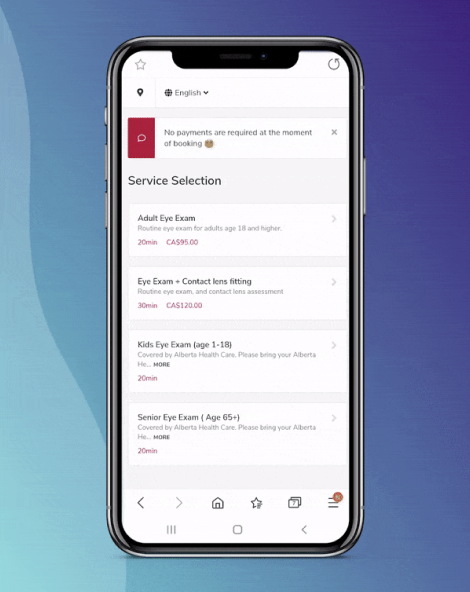
Book your eye exam at Charm Optical in south Edmonton
A comprehensive eye exam is $99 and includes retinal imaging. Eye exams are covered by Alberta Health Care for children and teens, for adults 65 and older, and for specific medical conditions — diabetic eye exams are covered at any age, with no referral needed. Appointments only, at 5035 Ellerslie Rd SW.
Not sure whether your appointment will include drops, or whether you need someone to drive you? Call and ask — we will tell you before you book. More on what an exam covers at our services page and how to find us.