
Optometrist vs Optician vs Ophthalmologist: Who You Need
Optometrist vs Optician vs Ophthalmologist: Who You Need
Book an optometrist first. In Alberta an optometrist examines your eyes, diagnoses eye disease and writes your prescription. An optician fits and dispenses the glasses or contacts that prescription calls for. An ophthalmologist is a medical doctor who performs eye surgery, and you usually reach one by referral. Most people need the optometrist.
Three job titles, three different licences, three different Alberta regulators. Booking the wrong one wastes a week. This guide sorts out who does what, then routes your exact situation to the right person.
Which one do you actually need?
Pick the line below that sounds most like you. Each one gives you the professional to call, how urgently, and the next step.
Tell us what is going on
Twelve of the most common reasons people phone an optical office in Edmonton, routed to the right professional. This is guidance, not a diagnosis.
- Optician
- Optometrist
- Ophthalmologist
- Emergency
“My glasses are out of date.”
The prescription drives everything else, and only an eye exam produces a new one. The same visit checks the health of the eye, which is the part people forget matters more than the number.
“I already have a valid prescription.”
No second exam needed. Bring the written prescription and an optician takes your measurements, fits the frame and orders the lenses. Check the expiry date first, because an out-of-date prescription cannot be dispensed.
“My glasses slip, pinch or sit crooked.”
This is opticianry, not medicine. Nose pads, temple angle and frame tilt get bent back into shape, usually in minutes. Phone ahead so someone is free when you arrive.
“I want to start wearing contact lenses.”
Contacts sit on the surface of the eye, so they need their own measurements and a health check that a glasses exam does not include. At Charm that is the $135 contact lens exam and fitting, and it is separate from the $99 glasses exam.
“I have diabetes and need my yearly check.”
Diabetes can damage the retina long before your vision changes. Alberta Health Care covers medically necessary eye care for specific medical conditions at any age, so ask when you book.
“My child failed a school vision screening.”
A screening flags a problem, it does not measure one. AHCIP covers one oculo-visual assessment and one diagnostic procedure per benefit year (July 1 to June 30) for Albertans 18 and under. If the benefit year's exam has not been used, the assessment is covered; ask when you book what is and is not included.
“I was told I have cataracts.”
The optometrist grades the cataract and tracks it. When it starts to limit driving or reading, they send the surgical referral. The surgery itself is done by an ophthalmologist, and your optometrist usually handles the follow-up care.
“Glaucoma or high eye pressure.”
Since 2015, Alberta optometrists who hold the Advanced Scope of Practice certification can manage and treat glaucoma independently, including prescribing the drops. Surgical or laser treatment goes to an ophthalmologist.
“Red, painful eye and light hurts.”
Pain plus light sensitivity is not conjunctivitis territory, it needs a slit lamp promptly. An Alberta optometrist who holds the Advanced Scope certification can prescribe the Schedule 1 or 2 drug that treats it.
Phone (780) 490-0090 and ask for the first available appointment · if nothing is open, Health Link 811 will route you
“New floaters, flashes or a shadow.”
A sudden burst of floaters, flashing lights, or a curtain moving across your sight can mean the retina is tearing. It needs a dilated look urgently, and if it is a detachment the referral to an ophthalmologist is immediate.
Phone (780) 490-0090 and ask for the first available appointment · if nothing is open or it is after hours, call Health Link 811
“Sudden vision loss or an eye injury.”
Do not phone an optical office and do not wait for an appointment. Sudden loss of vision, a chemical splash, or a penetrating injury goes to an emergency department. Flush a chemical splash with clean water on the way.
Call 811 or go to the nearest emergency department
“I want a copy of my prescription.”
Ask the office that did the exam. A glasses prescription and a contact lens prescription are two different documents, so if you wear both, ask for both. You can take either one anywhere you like.
Use the arrow keys to move between situations. Nothing here replaces an exam.
What does an optometrist do in Alberta?
The Alberta College of Optometrists describes optometrists as "university-educated, primary health care practitioners who examine, assess, diagnose, prescribe, correct, treat and manage diseases and disorders of the human visual system, the eye and its associated structures."
In plain terms: they are the front door. An optometrist measures your prescription, checks eye pressure, looks at the retina and optic nerve, and decides whether what they see needs treatment, monitoring or a specialist.
Alberta gives them more room than most provinces. On June 24, 2015 the province approved a revised Optometrists Profession Regulation. According to the Canadian Association of Optometrists, optometrists who complete the Advanced Scope of Practice Certification Course may prescribe, dispense or sell an oral or topical Schedule 1 or 2 drug incidental to the practice of optometry, manage and treat glaucoma independently, order and analyze laboratory tests, and order and apply ultrasound.
Training is a university degree followed by a four-year Doctor of Optometry program. They are not medical doctors and they do not perform surgery.
What does an optician do in Alberta?
An optician turns a prescription into eyewear you can actually wear. Alberta's alis occupational profile puts it this way: opticians "design, supply, prepare, adjust, and dispense optical appliances and prostheses, including corrective lenses, according to an optical prescription."
That covers frame selection, pupillary distance and fitting-height measurements, lens choice, verifying the finished pair against the prescription, and every adjustment afterward. Opticians who hold contact lens certification can also design, supply and assess contact lenses.
Two details people get wrong:
- Opticians do not diagnose. If something looks medically wrong, they send you to an optometrist or a physician.
- Alberta is one of a small number of provinces where an optician can apply to the College of Opticians of Alberta for a refracting designation. That allows sight testing. It is a narrower thing than a full eye health exam, and it is a separate certification, not something every optician has.
Entry to the profession is a minimum of two years of post-secondary training. The College of Opticians of Alberta replaced the former Alberta College and Association of Opticians on January 1, 2022.
What does an ophthalmologist do in Alberta?
The Canadian Ophthalmological Society defines an ophthalmologist as "a doctor of medicine who specializes in the diagnosis and treatment of disorders of the eye, in addition to diagnosing systemic disease that manifest in eye signs or symptoms."
The path is medical school, then a minimum five-year ophthalmology residency, with extensive surgical experience built into the final 24 months. Many then add one to two more years in a subspecialty such as retina, cornea or glaucoma. In Alberta they are licensed by the College of Physicians & Surgeons of Alberta like any other physician.
The Canadian Ophthalmological Society calls the ophthalmologist "the only health professional trained both medically and surgically to treat eye disorders" — which is exactly why they are the last stop, not the first.
Scope of practice, side by side
Here is who can legally do what in Alberta.
| Can they… | Optician | Optometrist | Ophthalmologist |
|---|---|---|---|
| Perform a full eye health exam | No | Yes | Yes |
| Diagnose eye disease | No | Yes | Yes |
| Write a glasses prescription | Only with a refracting designation | Yes | Yes |
| Measure, fit and dispense glasses | Yes | Yes | Rarely in practice |
| Fit contact lenses | With contact lens certification | Yes | Rarely in practice |
| Prescribe eye medication | No | Schedule 1 and 2, with Advanced Scope certification | Yes |
| Manage and treat glaucoma | No | Independently, with Advanced Scope certification | Yes |
| Perform surgery or injections | No | No | Yes |
| Alberta regulator | College of Opticians of Alberta | Alberta College of Optometrists | College of Physicians & Surgeons of Alberta |
| Training after high school | Minimum 2 years post-secondary | University degree plus 4-year Doctor of Optometry | Medical school plus 5-year residency minimum |
Scroll the table sideways to see all three columns.
Who can write your prescription?
Only an optometrist, an ophthalmologist, or an optician holding a refracting designation from the College of Opticians of Alberta. Everyone else is dispensing, not prescribing. Here is what each of those three products actually requires before anyone can hand it to you.


Do you need a referral to see an ophthalmologist?
In practice, almost always. The normal Alberta route is that your family doctor or your optometrist finds something, then sends the referral. Referral requirements do vary between clinics, so it is worth one phone call before you assume.
The useful part is that the referral is not a delay you are choosing. It is triage. The optometrist has already done the imaging, pressures and measurements, so the specialist starts from a file instead of from scratch.
The optometrist sits at the centre of the pathway. Glasses go one way, surgery goes the other, and post-operative follow-up commonly comes back.
What does each one cost in Alberta?
Alberta Health Care pays for some eye care and not other eye care, and the dividing line is age plus medical need. According to Alberta.ca, AHCIP covers one oculo-visual assessment and one diagnostic procedure per benefit year (July 1 to June 30) for Albertans 18 and under and 65 and over, plus medically necessary eye care for specific medical conditions at any age. Routine exams between 19 and 64 are not covered, and neither are glasses or contact lenses.
| Your situation | Who you see | What it costs |
|---|---|---|
| Adult 19 to 64, routine exam | Optometrist | Not covered by AHCIP. Charm's comprehensive eye exam is $99 |
| Child 18 and under | Optometrist | AHCIP covers one exam and one diagnostic procedure per benefit year |
| Senior 65 and over | Optometrist | Same AHCIP coverage as children |
| New or renewing contact lens wearer | Optometrist | Contact lens exam and fitting $135, separate from the $99 exam |
| Glasses made from a current prescription | Optician | Single vision from $99 complete, progressives from $350 |
| Medical eye problem, any age | Optometrist, then referral if needed | AHCIP covers medically necessary eye care for specific conditions |
| Eye surgery | Ophthalmologist | An insured physician service when medically required. Ask the surgeon's office what is and is not covered |
Sudden vision loss, a chemical splash, or an injury that penetrates the eye is an emergency department visit, not an appointment. Call Health Link at 811 or go straight to emergency.
Where Charm Optical fits
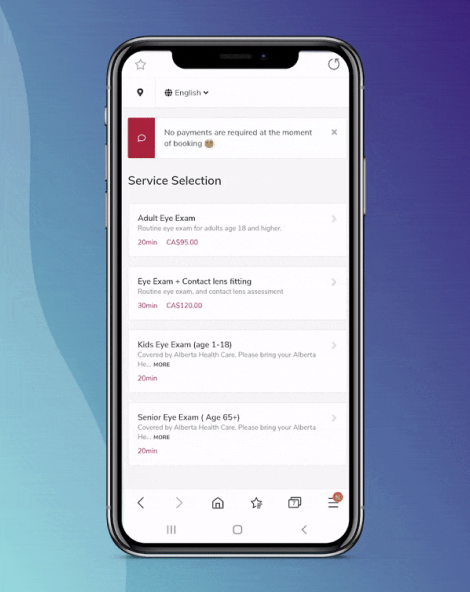
Charm Optical is both halves of the first two columns: an eye exam clinic and an optical store at 5035 Ellerslie Rd SW in south Edmonton. The exam happens here, the glasses and contact lenses are dispensed here, and you do not have to explain your prescription twice.
Two things worth knowing before you call. Charm is appointment only, so book online or phone ahead. And if what you have turns out to be surgical, you get a referral, not a sales pitch.
More about the clinic on our about page, or see the full list of services.
Frequently asked questions
What is the difference between an optometrist and an ophthalmologist?
An optometrist is a primary eye care provider who examines your eyes, diagnoses eye disease and writes prescriptions for glasses and contact lenses. An ophthalmologist is a medical doctor who also performs eye surgery. In Alberta most people start with an optometrist and are referred to an ophthalmologist only when surgical or specialist care is needed.
Can an optician write me a prescription?
Not by default. Opticians in Alberta design, prepare, fit and dispense glasses and contact lenses from a prescription someone else wrote. An optician who has received a refracting designation from the College of Opticians of Alberta can perform sight tests, but that is a separate certification and it is not the same as a full eye health exam.
Do you need a referral to see an ophthalmologist in Alberta?
Usually yes. Most ophthalmology appointments in Alberta come from a referral by a family doctor or an optometrist, and referral requirements vary between clinics. The practical route is to book an eye exam first. If the optometrist finds something that needs surgical or specialist care, the referral is sent for you.
Which one do I see for new glasses?
An optometrist if your prescription has expired or you have not been examined recently, because the exam is what produces the prescription. An optician if you already hold a current written prescription and only need the glasses measured, made and fitted. Charm Optical does both at 5035 Ellerslie Rd SW in south Edmonton.
Can an optometrist in Alberta prescribe medication?
Yes, within limits. Since June 2015, Alberta optometrists who have completed the Advanced Scope of Practice Certification Course may prescribe, dispense or sell an oral or topical Schedule 1 or 2 drug incidental to the practice of optometry, and may manage and treat glaucoma independently. Anything surgical still goes to an ophthalmologist.
How much does an eye exam cost in Edmonton?
A comprehensive adult eye exam at Charm Optical is $99 when AHCIP does not cover you. AHCIP covers one eye exam and one diagnostic procedure per benefit year for Albertans 18 and under and 65 and over. A contact lens exam and fitting is $135 and is not included in the $99 exam.
What should I do about a sudden change in vision?
Treat it as urgent. Sudden vision loss, a curtain or shadow across your sight, a burst of new floaters or flashes, an eye injury or a chemical splash all need same-day attention. Call Health Link at 811 or go to an emergency department. Do not wait for a routine appointment.
Start at the front door
Not sure which one you need? Book the exam.
The optometrist is the only one of the three who can tell you whether you need the other two. Comprehensive adult exam $99 when AHCIP does not cover you, at 5035 Ellerslie Rd SW in south Edmonton.
Sources
- Alberta College of Optometrists — definition of optometry practice.
- Canadian Association of Optometrists — Alberta scope expansion, June 24, 2015.
- College of Opticians of Alberta and alis Alberta occupational profile — optician duties, refracting designation, training.
- Canadian Ophthalmological Society — ophthalmologist definition and residency length.
- Alberta.ca — AHCIP optometry coverage.